
Top 10 Reasons Why Sri Lankans get UK Visitor Visa Refusal
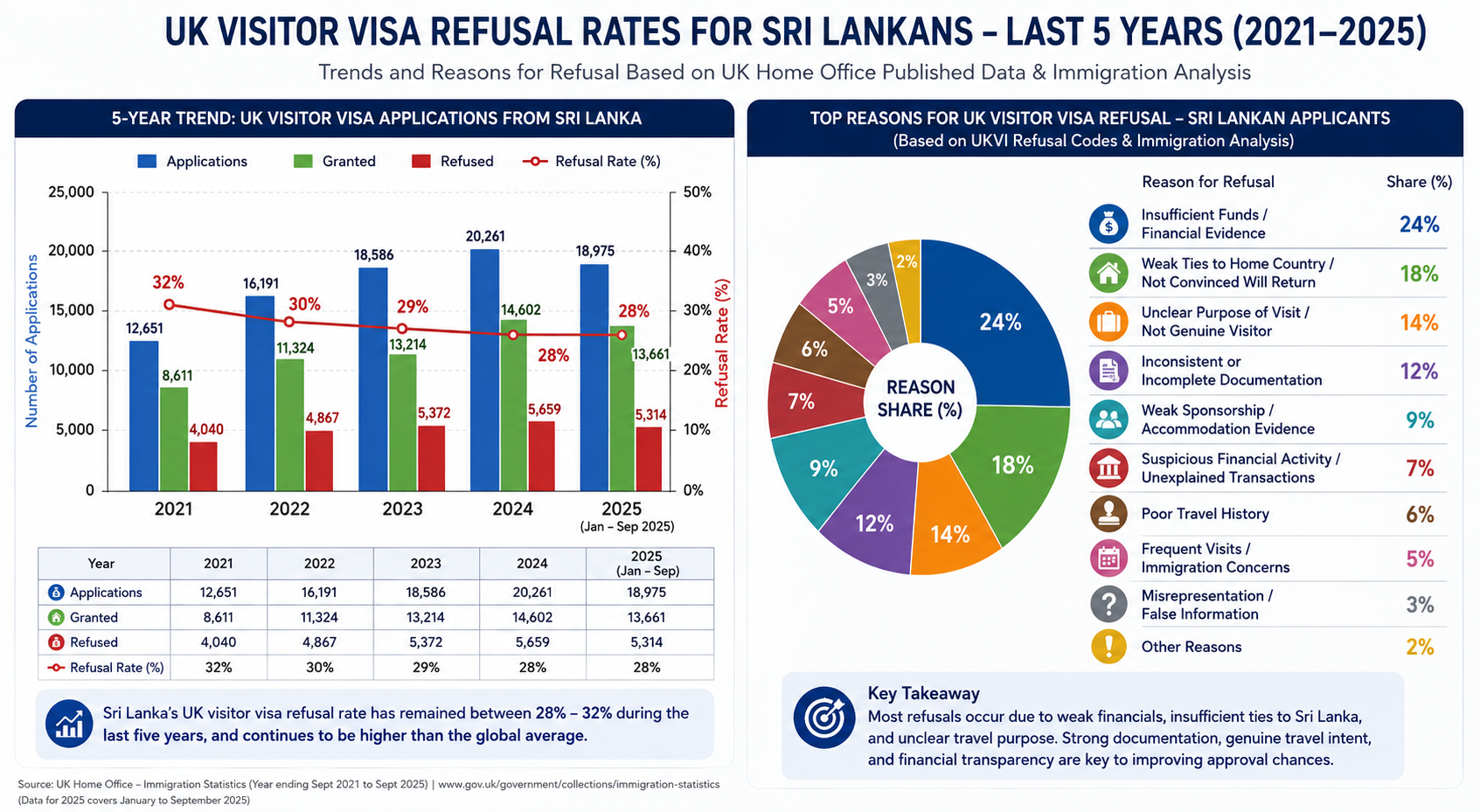
The United Kingdom remains one of the most popular travel destinations for Sri Lankans. Every year, thousands of people apply for UK visitor visas from Sri Lanka. Some travel for tourism. Others travel for family visits, graduations, business meetings, exhibitions, or short holidays. However, many applicants still face a major problem — UK visitor visa refusal in Sri Lanka.
For many families, a refusal becomes stressful and expensive. Applicants often spend large amounts on documentation, travel planning, accommodation bookings, and consultancy services before receiving a rejection.
Most people believe visa approval depends only on bank balances. Unfortunately, that is no longer true. Today, UK immigration officers assess applications very carefully. They focus on credibility, consistency, financial behaviour, travel history, and documentation quality.
In many cases, a refusal does not mean the applicant is unqualified. Instead, it means the application failed to explain the applicant’s situation properly.
At Archway International, many consultation cases involve genuine travellers who previously received refusals. Most of those refusals happened because of weak documentation, poor financial presentation, or inconsistent information.
This article explains the top 10 reasons behind UK visitor visa refusal in Sri Lanka. It also explains how applicants can improve their chances through proper preparation.
Understanding How UK Visitor Visas Are Assessed
Before discussing refusal reasons, it is important to understand how UK visitor visas are evaluated.
UK immigration officers carefully assess whether the applicant is:
- a genuine temporary visitor,
- financially capable of funding the trip,
- likely to return to Sri Lanka,
- travelling for a genuine purpose,
- and presenting truthful information.
The entire process depends heavily on credibility.
Visa officers compare several important factors, including:
- financial documents,
- bank statements,
- employment history,
- travel plans,
- sponsorship details,
- and travel history.
Even small inconsistencies can create doubts.
As a result, applications that appear “acceptable” may still get refused.
1. Weak Financial Presentation
Weak financial presentation remains one of the biggest reasons for UK visitor visa refusal in Sri Lanka.
Many applicants make the same mistake. They suddenly deposit large amounts of money before applying. However, this approach often creates suspicion instead of confidence.
UK immigration officers carefully review:
- savings history,
- income consistency,
- spending patterns,
- transaction behaviour,
- and source of funds.
For example, recent unexplained deposits can raise serious concerns. Similarly, low monthly income with expensive travel plans may appear unrealistic.
Other common financial problems include:
- borrowed money parked temporarily,
- inconsistent salary credits,
- weak banking patterns,
- and unclear business income.
The UK visa system focuses on genuine affordability. Therefore, officers prefer stable financial behaviour over artificially inflated balances.
At Archway International, applicants are often advised to prepare their financial profile gradually instead of making last-minute adjustments.
Strong financial documentation usually shows:
- stable income,
- realistic savings,
- transparent transactions,
- proper source of funds,
- and affordability matching the travel plan.
2. Lack of Strong Ties to Sri Lanka
A UK visitor visa is a temporary visa. Therefore, immigration officers must believe the applicant will return to Sri Lanka after the trip.
This is where many applications become weak.
If an applicant appears to have limited ties to Sri Lanka, the officer may suspect possible overstaying intentions.
Strong ties can include:
- permanent employment,
- registered businesses,
- family responsibilities,
- property ownership,
- ongoing education,
- or long-term commitments.
Applicants who recently resigned from jobs often face additional scrutiny. Similarly, financially unstable applicants may struggle to prove return intentions.
However, unemployment alone does not guarantee refusal. Instead, the applicant must provide stronger supporting evidence in other areas.
For instance, strong family ties or stable savings may help balance the application.
3. Poorly Written Cover Letters
Another major reason for UK visitor visa refusal in Sri Lanka is weak travel explanation.
Many applicants submit:
- copied templates,
- generic AI-generated content,
- incomplete travel plans,
- or poorly written cover letters.
Visa officers read hundreds of applications regularly. Therefore, weak narratives become easy to identify.
A strong application clearly explains:
- why the applicant is travelling,
- why the trip is necessary,
- how the trip will be funded,
- where the applicant will stay,
- and why the applicant will return home.
For example, an applicant claiming tourism should provide a realistic itinerary. Otherwise, the travel purpose may appear weak.
Likewise, family visit applications should clearly explain the relationship between the applicant and the sponsor.
At Archway International, visitor visa files are generally structured with connected documentation strategies. As a result, financials, sponsorship, and travel purpose align consistently.
4. Submitting Fake or Manipulated Documents
Submitting fake documents remains one of the most serious mistakes applicants make.
Unfortunately, some Sri Lankan applicants unknowingly depend on agents who create:
- fake bank statements,
- forged employment letters,
- fabricated salary slips,
- manipulated business documents,
- or false sponsorship papers.
Modern UK visa systems use advanced verification methods. Therefore, suspicious documents are often detected quickly.
Once fraud is identified, consequences can become severe.
These consequences may include:
- immediate refusal,
- future visa complications,
- credibility damage,
- and long-term immigration bans.
Even one fake document can damage the entire application.
Authenticity matters far more than appearance.
In many situations, a modest but genuine financial profile performs better than a fabricated high-value presentation.
5. Weak or No Travel History
Travel history plays an important role in UK visitor visa assessments.
Applicants with previous international travel often appear more credible. This happens because they have already demonstrated immigration compliance.
However, first-time travellers can still obtain UK visas successfully.
The problem usually arises when weak travel history combines with other concerns.
For example:
- poor finances,
- unstable employment,
- or unclear travel purpose
can increase refusal risks significantly.
Travel history helps officers understand behavioural patterns.
Previous travel to countries such as:
- UAE,
- Singapore,
- Malaysia,
- Thailand,
- Australia,
- and Schengen countries
may strengthen overall credibility.
6. Inconsistent Information Across Documents
Consistency is extremely important in UK visitor visa applications.
Many refusals happen because documents contradict each other.
Common examples include:
- salary figures not matching bank statements,
- inconsistent travel dates,
- different addresses,
- conflicting sponsor information,
- or unclear family relationships.
Immigration officers examine every detail carefully.
Even small inconsistencies may create doubts about honesty.
Therefore, every document should support one clear story.
Professional application review often helps identify these mistakes before submission.
7. Applying Under the Wrong Visa Purpose
Some applicants unintentionally misuse visitor visa categories.
For example, some applicants attempt:
- long-term study through visitor visas,
- employment-related activities,
- or migration-focused travel disguised as tourism.
However, UK visitor visas remain strictly temporary.
The immigration system clearly separates:
- tourism,
- business visits,
- family visits,
- short-term study,
- and work-related routes.
If the officer believes the applicant’s real intention differs from the declared purpose, refusal becomes highly likely.
Therefore, applicants must ensure their visa category genuinely matches their travel purpose.
8. Weak Sponsorship Documentation
Many Sri Lankan applicants rely on sponsorship support from relatives or friends living in the UK.
Although sponsorship is allowed, weak sponsorship structures often create problems.
Common sponsorship issues include:
- unclear sponsor finances,
- weak relationship evidence,
- unrealistic financial claims,
- missing accommodation proof,
- or incomplete supporting documents.
For example, an officer may question a sponsor with limited income who promises to support multiple visitors fully.
Strong sponsorship cases usually include:
- invitation letters,
- bank statements,
- employment documents,
- accommodation details,
- legal residence proof,
- and relationship evidence.
At Archway International, sponsorship-based applications are generally reviewed strategically to ensure logical financial and relationship alignment.
9. Overdependence on Unqualified Visa Agents
Sri Lanka has many unregulated visa agents operating without proper immigration expertise.
Unfortunately, many applicants trust these agents blindly. As a result, serious problems can occur.
Some agents use:
- copied SOPs,
- fake documents,
- fabricated employment records,
- or misleading strategies.
A UK visitor visa application is not just a form submission. Instead, it is a credibility-based documentary assessment.
Applicants should always:
- review documents personally,
- understand what is being submitted,
- and ensure all information remains truthful.
Professional guidance should improve transparency, not compromise it.
10. Reapplying Without Correcting Previous Problems
A previous refusal does not automatically destroy future approval chances.
However, many applicants reapply immediately without fixing the original issues.
This becomes a major mistake.
UK immigration officers can compare current applications with previous refusal records.
Therefore, unresolved weaknesses often lead to another refusal.
Strong reapplications usually include:
- improved documentation,
- corrected inconsistencies,
- better financial presentation,
- clearer travel explanation,
- and proper refusal analysis.
At Archway International, refusal recovery consultations often focus on identifying the exact credibility gaps behind previous refusals.
How Sri Lankan Applicants Can Reduce Refusal Risks
Although no consultant can legally guarantee a visa, proper preparation can improve approval chances significantly.
Build Financial Stability Early
Avoid sudden deposits before applying. Instead, maintain healthy banking patterns over time.
Prepare Genuine Documents
Every document should remain authentic, updated, and logically connected.
Present a Clear Travel Story
The travel purpose should appear realistic, structured, and believable.
Remain Transparent
Never hide previous refusals, immigration history, or financial concerns.
Seek Ethical Guidance
Choose professionals who focus on genuine documentation strategy instead of shortcuts.
Why Professional Visa Structuring Matters Today
Modern visa systems assess overall credibility, not paperwork quantity alone.
A professionally structured application can improve:
- financial clarity,
- documentation consistency,
- travel legitimacy,
- and return intention presentation.
As a result, many Sri Lankan applicants now seek structured consultation support before applying for UK visitor visas.
Archway International provides visitor visa consultation support for the UK, Canada, Europe, USA, and other international destinations.
Final Thoughts on UK Visitor Visa Refusal in Sri Lanka
Many UK visitor visa refusals happen because applications fail to communicate credibility properly. Today, UK immigration systems rely heavily on evidence, consistency, and documentation quality.
A strong application requires:
- transparency,
- realistic financial presentation,
- proper documentation,
- and believable travel justification.
For Sri Lankan applicants, understanding refusal reasons is the first step towards building stronger future applications.
Whether travelling for tourism, family visits, graduations, or business meetings, proper preparation can make a significant difference. In today’s immigration environment, preparation matters more than ever.